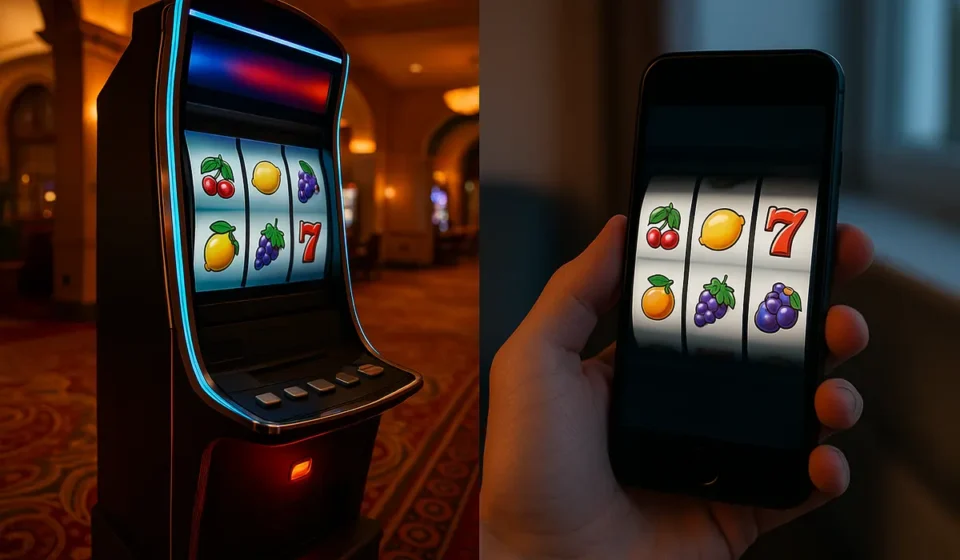

Somewhere on the floor at Regency Casino Thessaloniki, a cabinet that did not exist there a few months ago is now taking bets. It is a Type S 55J, it carries Amusnet’s slot content, and its twin stands at Regency Casino Mont Parnes. Down in the islands, Casino Rodos and Casino Corfu got the Type S 50F version. Four venues, one supplier’s first physical footprint in Greece, and a very useful natural experiment for anyone arguing about land-based vs online casino play, because a large chunk of that content already exists online in Greece. Same studio, same maths models, two completely different products.
That gap between the two is where most player misunderstandings live. Let me walk through what actually changes when a game moves from your phone into a steel cabinet.
Four cabinets, four casinos: why this install is worth reading closely
Amusnet is a digital-first company. Its Amusnet casino games have been familiar on regulated online sites for years, the classic fruit-and-sevens style slots with linked mystery jackpots sitting on top. The Greek rollout, announced in late September 2026, is its first land-based installation in the country, across Regency Thessaloniki, Regency Mont Parnes, Casino Rodos and Casino Corfu. Jelena Stankovic, a Director at Amusnet, framed it as a long-term commitment to Greece “across both Online and Land-based gaming”.
Read that phrasing again. Not “expanding into” land-based, but running both. The supplier now has the same brand of games in front of the same population of players in two settings, and it has to make each one work commercially in its own environment. That is not a copy-paste job, and the differences are not cosmetic.
The same slot, two different machines
Short answer to the question everyone asks: a land-based and online version of the same title usually share the artwork, symbols, paytable structure and bonus logic, but they can differ in spin speed, in which features are exposed, in stake range, and yes, sometimes in the configured RTP. “Same game” means same design, not identical product.
Game speed and session control
A physical cabinet imposes its own pace. Reels spin, sound plays, the win animation finishes before you can commit the next bet. In practice you are looking at a few hundred spins an hour, and you cannot rush it much.
Online, you control the clock. Quick spin, turbo mode and autoplay can double your rounds per hour, and that matters more than most people realise, because the house edge applies per spin, not per hour. Take a 4% edge (a 96% RTP game) at €1 a spin. At 400 spins an hour on a cabinet, the mathematically expected cost of that hour is about €16. At 600 spins an hour online, it is €24. Nothing about the game got worse, you just played more of it. Anyone who feels their money “disappears faster online” is usually describing this, not a rigged game.
The flip side: online gives you tools the cabinet cannot. Deposit limits, loss limits, session timers, reality checks and cool-off periods are built into licensed sites. On a casino floor, your limits are whatever cash you brought and whatever discipline you have at 1am.
Which bonus features make the trip
Feature sets are where suppliers make deliberate cuts. Physical cabinets are built around fast, legible rounds that a passing player can understand in three seconds, which favours expanding wilds, respins, free spins and the four-level mystery jackpot that links machines across a floor. Long interactive bonus rounds with menus and picks tend to get trimmed or simplified, partly for throughput, partly because a queue behind you is a real constraint.
Online versions keep the fiddly stuff: buy-a-bonus where regulation permits it, gamble features, multi-level pick rounds, and far wider bet ranges. A cabinet’s minimum credit is set by the venue, so you may not find the equivalent of a €0.10 online spin. If you like tiny stakes and long sessions, the browser wins that one outright.
RTP: the number that can quietly change between venues
Here is the part the industry rarely advertises. Slot manufacturers commonly ship a single title in several RTP configurations, and the operator picks one within whatever floor the regulator sets. That is true on both sides of the divide, but it bites harder in land-based, where you cannot check a help file before you sit down, and where two identical-looking cabinets in different venues can be running different settings.
The maths of why that matters is not subtle. Illustrative figures for €100 wagered across a session:
| Configured RTP | House edge | Expected long-run cost per €100 wagered |
|---|---|---|
| 96.5% | 3.5% | €3.50 |
| 94.0% | 6.0% | €6.00 |
| 92.0% | 8.0% | €8.00 |
Those are example settings to show the scale, not published figures for any specific Amusnet cabinet. The general pattern across the industry is that online RTPs cluster higher, roughly 94% to 97% on mainstream slots, because a website has no floor space, no cash handling and no staffing cost per machine. A cabinet has to pay for the room it occupies. Remember too that RTP is a long-run average over millions of rounds and tells you nothing about your afternoon, and that volatility, not RTP, decides how bumpy the ride feels. Our RTP explainer covers that distinction in more depth.
Practical advice: online, open the game info panel and read the stated RTP, because licensed sites must publish it. In a venue, check the machine’s help screens or ask, and treat the theoretical return as unknown until you have seen it in writing.
Atmosphere or armchair: the trade-off nobody wins
I have had better nights in a casino than I have ever had on a phone, and I have never once had a better value night. Both things are true.
A floor at Casino Corfu on a summer evening gives you things software cannot fake: the noise of other people winning, a drink arriving, the small ceremony of cashing a ticket, the natural stopping point when you walk out of the building. Travel, dress code and closing time act as accidental brakes on spend.
Online strips all of that away and replaces it with access. Lower minimum stakes, no travel, thousands of titles including live dealer tables, demo modes to learn a paytable at zero cost, and total privacy. It also removes every natural brake, which is why the built-in limit tools are not decoration. If you play at home, set a deposit cap before you need one.
| Factor | Land-based (e.g. Regency, Casino Rodos) | Online |
|---|---|---|
| Spins per hour | Lower, fixed by the cabinet | Higher, player-controlled |
| Minimum stake | Set by venue, usually higher | Often a few cents |
| RTP transparency | Harder to verify on the floor | Published in the game info panel |
| Feature depth | Streamlined, jackpot-led | Full feature set, wider bet range |
| Rewards | Comps: drinks, food, hotel, events | Bonuses with wagering requirements |
| Control tools | Self-exclusion, staff intervention | Deposit, loss and session limits, cool-off |
What omnichannel casino gaming actually delivers
Omnichannel casino gaming means one supplier’s content, brand and often loyalty identity following you between the floor and your phone. Amusnet’s Greek move is a textbook version: recognisable titles and jackpot mechanics in four venues, with the online catalogue already there.
The genuine benefit to players is familiarity. You learn a paytable on a cabinet in Rhodes and you already understand the online version, and vice versa. Some markets take it further, with venue loyalty cards that also track digital play, so tier points earned online buy a hotel night. Where that exists, it can be worth real money.
The honest caveat is that omnichannel is a retention strategy first. Making the two channels feel like one product is designed to keep you inside one brand, and being recognised by a loyalty programme is not the same as being offered a better game. The RTP configuration, not the branding, decides what the session costs.
Land-based vs online casino: which format is better value?
On pure cost per spin, online generally wins. Higher typical RTPs, lower minimum stakes, demo play, and promotions that add measurable value if you read them properly. That last point is the catch: a €200 bonus at 30x wagering means €6,000 must be staked before withdrawal, game weighting decides how fast that clears, and max bet caps apply while the bonus is live. A bonus you cannot realistically clear is worth nothing.
Land-based value comes in a different currency. Comps are real, immediate and not subject to rollover. Free drinks, a buffet, a discounted room, invitations to events, and at higher stake levels, host attention. If you were going to spend the evening out anyway, a couple of hours on a cabinet at a slower spin rate with a meal attached can compare surprisingly well against a fast online session.
My blunt read: online is the more efficient place to play, land-based is the better place to spend an evening, and neither is a way to make money. Both formats are built on a house edge that grinds in the operator’s favour over time, and the only variable you fully control is how much you wager and for how long. Set a budget, use the limit tools online, and if the fun stops, stop. Responsible gambling resources are worth bookmarking before you need them.
Common questions
Are land-based casino games the same as online versions?
Usually the same design and paytable structure, but not identical products. Spin speed, stake range, feature depth and the configured RTP can all differ between a cabinet and the online build of the same title.
How do RTP rates compare between physical and digital versions?
Online slots typically sit in the 94% to 97% range and must publish their figure, while land-based machines run whatever setting the venue chose within regulatory limits and are harder to verify on the spot. Manufacturers commonly supply multiple RTP configurations of one game.
What does Amusnet’s Greek install tell us about omnichannel gaming?
That casino slot providers increasingly want the same brand in both channels. Four Greek venues, Type S 55J and 50F cabinets, plus an existing online presence, means players meet the same games in two settings with different economics behind them.
Is online cheaper to play than a physical casino?
Per spin, usually yes, thanks to higher typical RTPs and lower minimums. Per hour, not necessarily, because online play is faster and speed multiplies the house edge.