
Nice visuals stopped being enough
Would you be able to tell, in the first thirty seconds, whether a crash game is worth your money? Most players can’t, because they are judging the wrong thing. They look at the plane, the rocket, the particle trails. Meanwhile the parts that decide whether the game is fair and whether it’s actually fun to play sit behind an info button nobody taps.
Levan Kavtaradze, Head of Partner Management at Galaxsys, put it bluntly in an interview with Focus Gaming News ahead of SBC Summit Lisbon: “Simply launching another game or having nice-looking visuals is no longer enough.” He was talking to operators, not players, but the point lands harder on our side of the screen. When dozens of crash games use the same rising-multiplier loop, art direction is the cheapest thing to copy. Mechanics, verifiable fairness and the small quality-of-life features are what take real engineering.
So let’s do this the practical way. Say you have ₹500 and two crash games open in two tabs. One looks like a mobile blockbuster. One looks like it was built in 2019. We’re going to walk through the same checks I’d run on both, in the order you’d actually run them, and see which one survives.
What actually makes crash games fair and engaging
Before you place a single rupee, open the game info panel. You’re looking for four numbers and one word: RTP, house edge, minimum and maximum stake, maximum multiplier, and the word “provably”. If the game hides all of that, that’s your answer already.
Provably fair technology explained
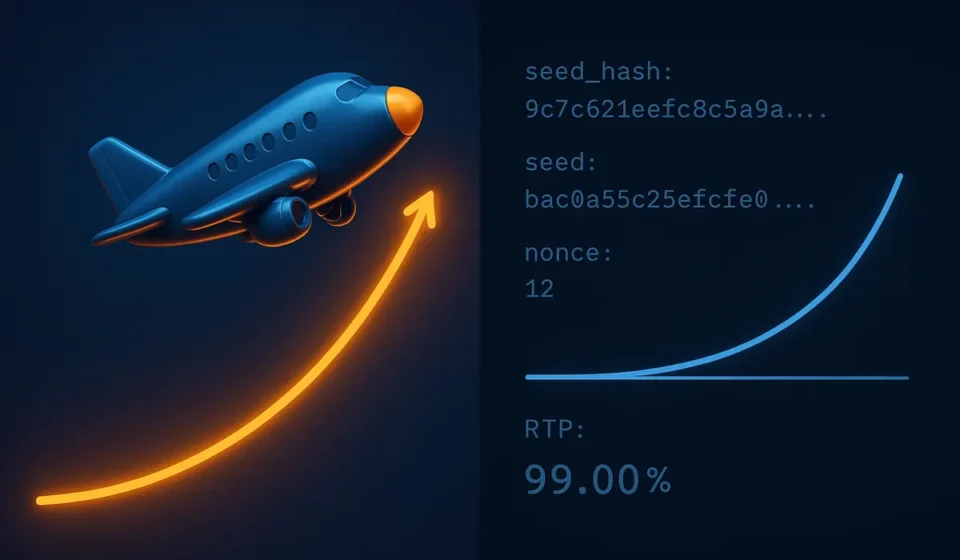
Provably fair means you can verify after the round that the crash point wasn’t tampered with. The mechanism is cryptographic, and it usually runs like this:
- Before the round, the server generates a secret seed and publishes its hash. A hash is a one-way fingerprint, so you can’t work backwards to the seed, but the server can no longer change it without the fingerprint breaking.
- A client seed adds randomness the operator doesn’t control. Some games pull it from the players in the round, others use a future public value such as an upcoming blockchain block hash.
- The two seeds are combined and run through a published formula that converts the result into a crash multiplier.
- After the round, the server reveals its seed. You hash it yourself, check it matches the fingerprint published earlier, then re-run the formula and confirm the multiplier you got.
Two things follow from that, and both matter. First, the crash point exists the moment the round starts. It is not being decided while you watch the multiplier climb, and it is not reacting to your bet size. Second, verification only counts if the game actually gives you the tools: a fairness tab, the seed history, and a verifier. A game that says “provably fair” in the marketing copy but offers nothing to check is making a claim, not a promise.
Provably fair isn’t the only credible model. Plenty of quality crash and instant win games instead use a certified RNG audited by an independent testing lab, with the certificate tied to a licensed studio. That’s a different kind of trust: you’re relying on the auditor and the regulator rather than on maths you can run yourself. Both are legitimate. Neither certificate nor seed hash changes the house edge.
RNG, multipliers and where the house edge hides
The RNG produces a random value each round, and the game engine maps that value onto a multiplier curve. The shape of that curve is the whole design. A typical implementation gives you a long tail of small multipliers, a thinner tail of big ones, and a slice of rounds that crash instantly at 1.00×. That instant-crash slice is where most of the house edge lives.
Published RTP on crash titles usually sits in the mid-90s, so call it roughly 96%. That means around ₹4 of every ₹100 wagered is retained by the house on average, over an enormous number of rounds. Here’s the part players get wrong: your cash-out strategy changes the shape of your results, not the edge. Auto cash-out at 1.10× gives you frequent small wins and occasional painful losses. Holding for 10× gives you long dry spells and rare big hits. Both carry the same negative expected value, because that value is baked into the multiplier distribution before you do anything. Volatility is a preference. The edge is a fact.
Transparency in game outcomes
Now check the history. A good crash game shows you the last 50 to 100 crash points, and lets you click any round to see the seed data and the full bet list for that round. A weak one shows you a pretty coloured ribbon of recent multipliers and nothing behind it.
Use that history for verification, not prediction. Every round is independent, so a run of eleven low multipliers tells you precisely nothing about the twelfth. Any “pattern” you spot in the ribbon is your brain doing what brains do. The history’s real job is to let you confirm the game did what it said it did.
The mechanics and features that separate leading crash games
Back to our two tabs. The glossy one has a plane, a soundtrack and a single bet button. The plain one has all of this:
- Auto cash-out and auto bet. Set your exit multiplier and number of rounds so you’re not fighting your own reflexes. This is the single most useful control in the format, and the fact that it reduces impulsive decisions matters more than the convenience.
- Dual betting. Two independent stakes in the same round, typically one on a low auto cash-out and one held higher. It’s a variance tool, not an edge tool.
- Partial cash-out. Take part of the stake out and let the rest ride.
- Personal statistics. Total wagered, total returned, session length, biggest multiplier caught. Transparent accounting of your own play is a responsible-gaming feature as much as a stats feature.
- Live bet feed and chat. Seeing other players’ stakes and exits in real time is what gives crash games their shared, social pulse. It also means the game can’t quietly show you a different round than everyone else.
- Performance under bad connectivity. On a patchy mobile network, a lightweight game that keeps the cash-out button responsive beats a heavy 3D build every time. If a frame drop costs you your exit, the graphics were a liability.
That list is the mechanics-first shift Kavtaradze is describing. Operators now buy engines, feature depth and integration quality. Players should be buying the same thing.
How to evaluate crash games like a pro
Here’s the checklist I’d run before depositing, and the warning signs that should stop you.
| What to check | What good looks like | Red flag |
|---|---|---|
| RTP | Stated in the info panel, with the figure visible before you bet | Not published anywhere, or “varies” with no range |
| Fairness model | Working provably fair verifier, or an independent lab certificate and a named licence | “Provably fair” claimed with no seeds, hashes or verifier |
| Round history | Clickable past rounds with seed and bet data | Decorative multiplier strip only |
| Stake limits | Clear minimum and maximum in rupees, plus a stated max payout cap | Payout cap buried in terms or absent |
| Controls | Auto cash-out, auto bet, partial cash-out, session stats | Manual cash-out only |
| Provider | Named studio you can look up; game runs identically across casinos | Unbranded clone, no provider credited |
One more test, and it costs nothing: play in demo mode for 100 rounds with a fixed auto cash-out. You’ll learn the game’s real volatility, feel whether the interface responds when it matters, and see whether the excitement survives once the novelty of the animation wears off. If it doesn’t, the graphics were carrying the whole thing.
The Galaxsys approach to modern crash games
Galaxsys is a useful case study precisely because it builds across the instant-win category rather than shipping one crash clone. The lineup Kavtaradze took to SBC Summit Lisbon, InstaWin, Infinity, Tower Rush and Olympian Legends, spans several fast-round formats rather than four variations on a rising plane. That’s a portfolio strategy built on mechanics, and it only works if the underlying game engine, the maths and the feature set are strong enough to carry different themes.
His framing is the takeaway for players too. If launching another game with nice visuals is no longer enough for operators, it shouldn’t be enough for you either. The questions worth asking are whether the RTP is published, whether the fairness claim is checkable, whether the controls let you play deliberately, and whether the round history is real data or decoration.
And keep the maths honest with yourself. Understanding how crash game mechanics work makes you a better-informed player, not a winning one; the house edge applies to every strategy and every round. Set a deposit or loss limit before you start, use auto cash-out to keep decisions out of the heat of the moment, and stop when the session limit hits rather than when your instincts say one more round.
FAQ
What makes crash games fair?
Either a provably fair system, where a hashed server seed is published before the round and revealed afterwards so you can reproduce the crash point yourself, or a certified RNG audited by an independent testing lab under a gaming licence. Fair means verifiable and random, not free of a house edge.
How do crash game mechanics work?
The RNG generates a value at the start of the round, the engine converts it into a crash multiplier, and the multiplier then animates upward from 1.00× until it reaches that pre-set point. Cash out before it does and you keep stake × multiplier. The crash point is fixed before the animation begins.
What separates good crash games from clones?
Published RTP, a fairness model you can actually check, detailed round history, auto cash-out and auto bet, session statistics, a live bet feed, and a lightweight build that stays responsive on mobile data. Visual polish is nice; none of the above can be faked with artwork.
Gambling should be treated as paid entertainment, never as income. Only play with money you can afford to lose, use deposit and session limits, and seek support if play stops feeling like a choice. 18+ only.