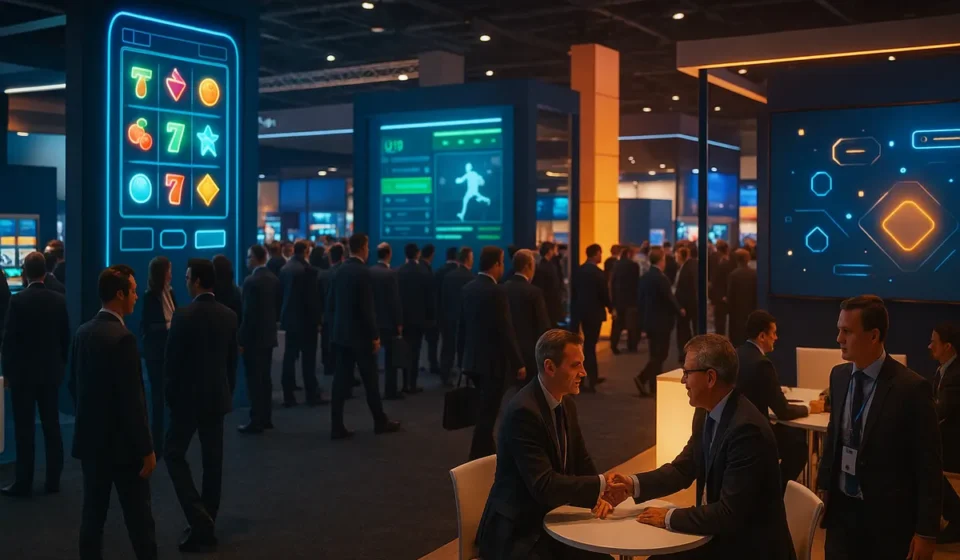

Why would an online casino that has never had a front door pay to rent floor space in a convention centre? It is a fair question, and the answer says something useful about how the industry works. An iGaming exhibition is where the business behind your account gets built: licensing conversations, payment contracts, game supply deals, compliance advice. None of that happens on the site you log into, but all of it shapes what you experience there.
For a player trying to judge whether an operator is a serious business or a thin white-label wrapper, exhibition behaviour is one of several signals worth reading. Not the most important one, and not a guarantee of anything. Just a signal that most people never think to look at.
What actually happens at an iGaming exhibition?
These are business-to-business events, not consumer expos. If you walked onto the floor at SBC Summit, ICE, SiGMA or G2E expecting free spins and a chance to play, you would be disappointed. The attendees are operators, game studios, payment processors, affiliate networks, regulators, law firms, data providers and platform vendors. The “product” on display is infrastructure.
Four things dominate the calendar at a typical event:
- Commercial meetings. Pre-booked, back-to-back, usually in a meeting room behind the stand. A brand can compress a quarter of business development into three days.
- Regulatory and legal discussion. Conference tracks on new market rules, advertising restrictions, player protection standards and tax treatment, often with regulators speaking directly.
- Product demonstrations. Game studios show unreleased titles and mechanics; platform providers show back-office tools, bonus engines and risk systems.
- Recruiting and reputation work. Hiring, press meetings, awards, and the informal reputation trading that happens over coffee.
Worth distinguishing this from consumer gaming events like the big video game shows. Those exist to sell to players. An iGaming trade show exists to sell to the companies that sell to players.
Which deals actually get done face-to-face?
The honest answer: the ones that involve trust, money movement and legal exposure. B2B iGaming networking works because these contracts are not commodity purchases you can safely make from a product page.
Think about what an operator needs to run a market like India properly. A payment provider that can process local methods reliably, handle failed transactions and survive a bank’s risk review. Game content from studios whose titles players actually recognise. A KYC and anti-fraud vendor. A compliance consultancy that understands which licence works for which market. Affiliate partners who will send traffic on credit terms before they have been paid a rupee.
Every one of those relationships involves someone extending trust first. A payment processor takes on chargeback and reputational risk. An affiliate fronts marketing spend for 30 to 60 days. A game studio hands over content and hopes the revenue share report is accurate. People are slower to take those risks with a company that exists only as a logo on a video call.
There is also the pricing reality. Revenue shares, minimum guarantees, exclusivity windows and settlement terms get negotiated faster in a room than across three weeks of email. Sitting down with four competing suppliers in one afternoon also tells a commercial director more about the real market rate than any rate card will.
What does exhibition presence tell you about brand credibility?
It tells you the brand has a budget, a business development function, and something to gain from being seen by the industry rather than hiding from it. That is genuinely informative, because the opposite pattern is common. Operators built for short-term extraction tend to avoid rooms full of regulators, journalists and suppliers who will ask awkward questions about payouts and licence status.
Brand credibility for an online casino is mostly built out of unglamorous, checkable things: a named licensing authority, audited game content, disclosed corporate ownership, published terms that match how the account actually behaves. Exhibition participation is a secondary layer on top of that. A company with a large stand and an executive speaking on a payments panel is publicly attaching its name and face to its claims in front of people who could contradict them.
Be careful not to overread it, though. A big stand proves marketing spend, not fair treatment of players. Some heavily promoted brands have poor withdrawal reputations. Use exhibition presence as a supporting signal alongside licensing checks, not as a substitute for them. If you want the primary checks first, start with how casino licensing and regulation actually work.
Why do digital-first brands still show up in person?
Because three specific jobs resist being done remotely, and all three matter more as a brand grows.
Regulatory relationship-building. Licensing is not a vending machine. Applications involve suitability reviews, technical audits, ongoing reporting and, frequently, judgement calls. Operators who have met the people at authorities such as the Malta Gaming Authority or the UK Gambling Commission, and who attend the sessions where new rules are explained, tend to be better prepared when requirements shift. Casino industry events are one of the few settings where regulators, operators and suppliers are in the same building on purpose.
Competitive intelligence. You cannot read a market’s mood from a dashboard. Which supplier everyone is quietly avoiding, which payment corridor is breaking, which jurisdiction is about to tighten advertising rules, whether a promotional trend is working or just loud. That information circulates in conversation weeks before it appears in a report.
Reputation among the people who can block you. Banks, processors, platform partners and media all make judgement calls about who they work with. Being a known quantity is an operational advantage. It is easier to get a problem escalated when the person on the other end has met you.
There is a fourth, less flattering reason: visibility attracts inbound deals. A stand is a lead magnet for suppliers and affiliates who might never have made contact otherwise.
How can you use trade show history to judge an operator?
Start with the public record. Event organisers publish exhibitor lists and conference agendas, and those pages stay online for years. Industry trade press covers stands, panels and awards. Operators themselves usually post about attendance on their news or LinkedIn pages. Searching an operator’s name alongside the name of a major iGaming trade show takes about a minute and gives you a rough sense of whether the company operates inside the industry’s mainstream or at its edges.
Then read the tier. Different levels of participation carry different weight.
| Level of participation | What it usually involves | Reasonable inference |
|---|---|---|
| Delegate pass only | Staff attend, no stand | Small or early-stage team, or a purely cost-driven choice. Tells you very little on its own. |
| Small or shared stand | Pod in a start-up zone, one or two staff | Active business development with a modest budget. Growing, not yet established. |
| Large custom stand | Purpose-built space, staff from several departments, private meeting rooms | Funded operation running multiple markets and supplier relationships. |
| Conference speaker | Compliance, payments or marketing executive on a panel | Peers consider the company’s experience worth hearing. Often a sign of regulated-market activity. |
| Headline sponsor or awards presence | Event-wide branding, named awards, hospitality | Large marketing budget and scale ambitions. Says nothing directly about player treatment. |
Two patterns are more telling than the tier itself. First, consistency: a brand that has appeared at the same events for several years in a row is likelier to still be there next year than one that surfaced once. Second, the type of event. Presence at conferences focused on regulated markets and compliance carries more weight than presence at purely affiliate-marketing gatherings.
For players in India, add a layer of local realism. Most operators accepting Indian players hold offshore licences, and Indian rules on real-money online gaming vary by state and have been changing, so check your own legal position before you play. What exhibition history can help with is the narrower question of whether the company behind the site is an established business with real supplier relationships, or a brand that appeared six months ago with no traceable industry footprint. Pair that with the practical checks that matter more day to day: licence verification, withdrawal terms, wagering requirements on any bonus, and how securely your payment method handles deposits and payouts.
Where this signal stops being useful
Exhibition presence is a filter, not a verdict. It can be bought. A well-funded operator with a bad complaints record can still build the biggest stand on the floor, and a genuinely decent small operator might never exhibit at all because the money is better spent elsewhere. Treat it the way you would treat a company’s office address: reassuring when present, worth a raised eyebrow when nothing exists at all, and no substitute for reading the terms.
The sequence I would use: confirm the licence and who holds it, read the withdrawal and bonus terms, check independent complaint histories, then look at industry footprint including trade show participation as a tiebreaker between similar-looking options. Our guide to evaluating casino credibility walks through the earlier steps in more detail.
One last thing worth saying plainly. Every casino game is built with a house edge, so the house profits over time regardless of how legitimate the operator is. Researching credibility protects your money from being mishandled; it does not change the maths of the games. Set deposit and time limits, treat the spend as entertainment, and use the self-exclusion tools any properly licensed operator is required to provide if it stops feeling that way.